| Whit's Scots Oor Authors Oor Illustrators |
Aboot Us
Itchy Coo was founded in 2002 by James Robertson and Matthew Fitt.
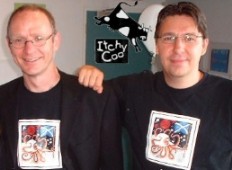 Itchy Coo is an imprint which publishes bestselling books in Scots for children and young people. Itchy Coo was founded in 2002 by Matthew Fitt and James Roberston.
James Robertson is our General Editor.
Itchy Coo also promotes Scots to the wider public through liaison with the Scottish Parliament, national organisations and at international level.
Our aim is to encourage better understanding and greater acceptance of the Scots Language in education and in all aspects of Scottish life.
Publishing
Since 2002, the Itchy Coo publishing imprint has produced 36 titles. In partnership with Black & White Publishing, with initial funding from the National Lottery, and subsequent yearly funding from the Scottish Arts Council, Itchy Coo has become an established imprint within Scottish publishing. It has'sold almost a quarter of a million books.

Education
For the past seven years, Itchy Coo has been working with pupils, staff, teacher training institutes, libraries, local authorities and national organisations to promote Scots within education. With funding from the Scottish Arts Council and local authority education departments, Itchy Coo has made close to 1000 visits to schools and libraries and has delivered over 200 in-service training sessions in almost every area of Scotland.
Outreach
Matthew Fitt and James Robertson have represented Itchy Coo at the United Nations and Tartan Week in New York. They have provided advice and information on the Scots Language to the Scottish Government, Council of Europe, British Council, Learning & Teaching Scotland, Her Majesty’s Inspectorate of Education, General Teaching Council, Literature Forum for Scotland and at national and international conferences.
Matthew is currently Secretary of UK EBLUL (European Bureau for Lesser Used Languages).